
Each purchase empowers underprivileged children, with several meals provided and counting. Learn More
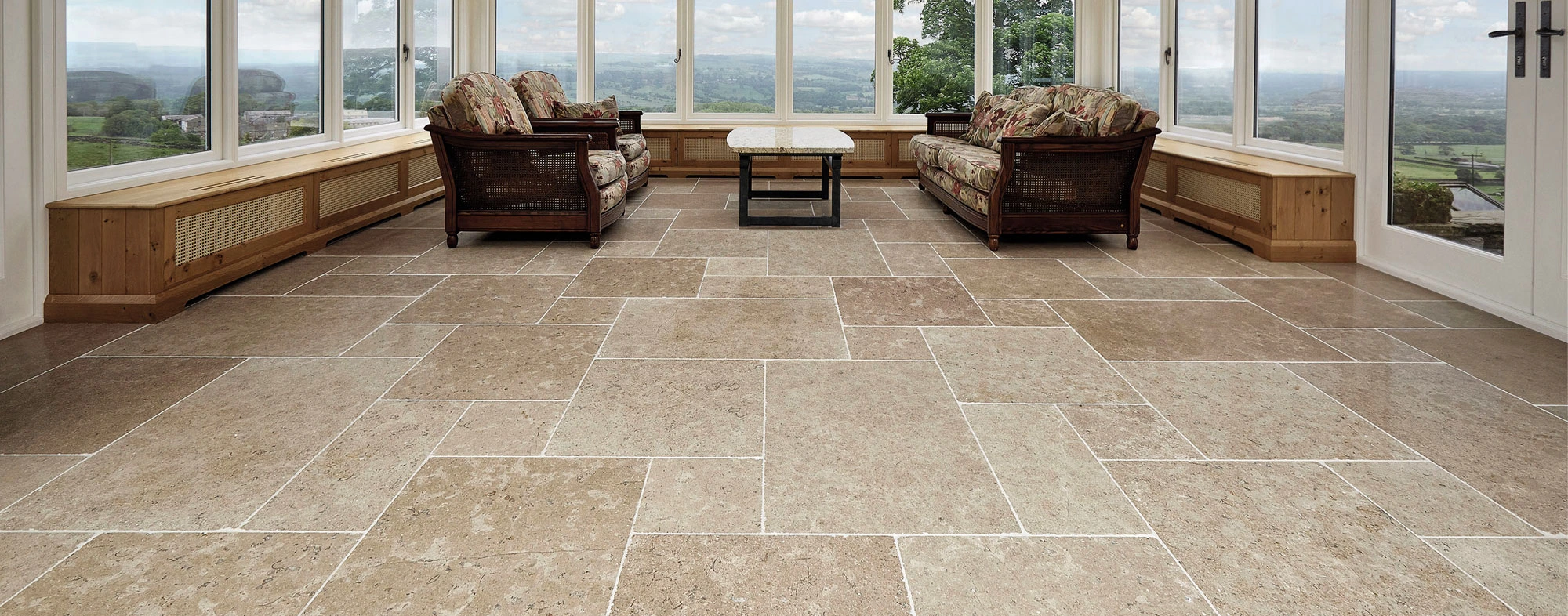
Which way up?
There seems to be some confusion about the way you lay natural stone. Please see the diagram as detailed below…
Strata Setts are a traditional styled natural paving ideally suited to driveways and forecourts, as well as paths and patios. We have provided this installation guidance to help ensure you get many years of trouble-free service. Installation tips such as this can never be comprehensive for every project and we urge you to seek professional on-site advice for any specific issues not covered in this brief guide.
Setts need to be laid to falls to ensure that any water on the surface will drain away properly. We recommend a fall of at least 1:60, which is equivalent to 17mm per linear meter. Obviously, site conditions may require the paving to have a greater amount of fall, but 1:60 should be regarded as an absolute minimum. Bear in mind that government legislation covering paving in front gardens, which often includes driveways, will require the paving to be drained to a soakaway or similar SUDS-compliant installation, or planning permission will be required. Your local council should be able to advice on what is required in your area.
The area to be paved needs to be cleared of all vegetation and topsoil, to a depth of at least 130mm. Remember: paving should always be laid at least 150mm lower than the Damp Proof Course (DPC) of any adjacent building.
Use taut string lines as guides to both alignment and surface level. These can be fastened to pegs knocked into the ground or nails fixed into masonry. Use string lines at the edges and then use a long timber straightedge to span from the setts to the string lines to check for level.
Setts need to be laid onto a full bed of mortar or concrete. Where the setts will be trafficked by vehicles, the paving needs to be laid onto a bed of concrete at least 100mm thick. Some installers choose to lay directly onto the concrete while others prefer to construct a 100mm thick concrete base first and then bed the setts into mortar over the top of the base. Both techniques have their pros and cons, and both produce equally good results when done properly, so it is a matter of choosing which technique best suits the project in hand and the skills of the installer.
Sett pavements are traditionally edged with ‘channel course
of setts laid lengthways and following the perimeter of the area. The channel course may be one, two or three setts wide depending on personal taste. It’s a good idea to lay out a sample panel of setts on sand or on flat ground beforehand to determine which arrangement best suits the project.
Channel courses are always laid first. They define the boundary of the pavement and act as a guide to level for the main area of paving.
The remainder of this guide considers laying Setts directly onto concrete or mortar. For guidance on laying onto mortar over a concrete base, the techniques outlined in the ‘Laying Flagstones’ section can be followed.
The Setts need to be laid onto at least 100mm thickness of reasonably strong concrete or mortar, which can be mixed on-site as and when required, or brought in as ready-mix from a local supplier. Ready-mix concrete is sold in ‘cubic meters’ and each cubic meter will be sufficient to lay approximately 10 square meters of Setts. However, you should be aware that concrete (and mortar) have a limited working time and will need to be used within 60-90 minutes.
The concrete should have strength of around 20 Newtons. It may be a traditional concrete comprising gravel, sand and cement, or a coarse mortar comprising sharp, gritty sand mixed with cement.
Site mixed concrete/mortar is often a better option for DIYers and those contractors that do not lay setts on a regular basis. It allows the installer to mix the bedding material as it is required, to minimize wastage, and to work at a pace that suits their personal skill level.
For a concrete bed, mix 4 parts of 10mm gravel with 2 parts sharp sand and 1 part cement. Alternatively, use 5 parts all-in ballast with 1 part cement. For a mortar bed, mix 4 parts sharp sand with 1 part cement.
It’s best to use a powered mixer to prepare the mortar/concrete. These can be hired locally for around £30 per week, if necessary. Mix only as much bedding material as will be used in 30-60 minutes. Mortar and concrete starts to harden as soon as it is mixed and, in warm weather, it may become ‘stiff and unworkable in as little as 20 minutes.
Be sure to wear protective eyewear and gloves when mixing mortar or concrete. Cement is strongly alkaline when wet, so dust or splashes can damage your eyes and your skin. Wear long sleeved clothing and wash any splashes with clean water immediately. You should wear protective gloves at all times, as they will help protect your hands from abrasion while handling tools and paving units. The concrete/mortar should be damp or moist, but not too wet. A good test of consistency is to squeeze a handful of the material while wearing protective gloves. The material should clump together but there should be no excess water running from it.
Setts are laid in courses, whether they are the channel courses at the edges or the main body of the paving. Each course is laid against a taut string line which acts as a guide to alignment and level, and it is customary to complete one course before proceeding with subsequent courses. Working from the unpaved edge of the pavement, spread the bedding material where it is required to a depth of around 110-120mm, ie: roughly at the same height as the paving will be when completed, and level it out using a trowel. Spread the material wider than the course of setts being laid.
Place the Sett onto the levelled bed, allowing a finger-width joint between the sett and any hard edge such as a wall, a kerb or a previously laid sett. Use the rubber mallet to gently but firmly tap down the sett until it is at the correct level and alignment as indicated by the taut string line. If the unit goes down too far, lift it out, and use the trowel to add a little extra bedding material before re-placing the sett and tapping down again.
Use a straightedge over the tops of the setts to check that they are reasonably level with no high spots or hollows. Check each course before moving on to the next as it can be difficult to access mistakes once further setts have been laid. Remember to check the alignment as well as the level. Bear in mind that the hand-trimmed edges of natural stone Setts will be slightly irregular so it may be necessary to adjust the position of some setts to create a tidy-looking course. When judging alignment, the usual rule of thumb is that, if it looks right, it *is* right!
When laid, the Setts should not be walked upon for at least 24 hours, preferably 48 hours. This gives the bedding time to harden and support the Setts without sinking or settling.
After this period, it is essential that anyone walking across the setts takes great care not to disturb the alignment. While the bedding will have hardened and will prevent the setts from sinking, they 10-12mm wide joints are empty and there is a risk that the units can be accidentally knocked out of alignment.
There are several methods that can be used to joint Setts, but we will look at just two of the most popular: cement mortar and resin mortar.
Cement mortar is relatively cheap, but it can be time-consuming and it often leaves a cement haze over the setts that may take several weeks to weather away. Resin jointing is very quick, very clean but much more expensive.
For cement mortar jointing, a mortar comprising 3 parts soft or building sand is mixed with 1 part cement to a consistency that is very wet, like that of a pea soup. This is spread over the pre-wetted setts and swept into the joints using a stiff brush. The excess is swept off, repeating the sweeping until as much as possible of the mortar is removed, and eventually switching to a soft brush to remove the finer particles. The surface needs to be gently sprayed with clean water throughout to help with the cleaning. Once the joints are filled, they can be smoothed using the blade of a pointing trowel or a special „pointing bar ? that will give a flat or semi-round profile to the joint.
Cement mortar jointed setts should be kept free of foot traffic for at least 3 days and vehicles are best kept off the paving for at least 7 days, preferably longer.
Resin mortars are applied in a similar manner. Some products come pre-mixed and simply need opening, emptying onto the pavement surface and brushing into the joints, while others require mixing of the resin components with the selected aggregates. You should follow the advice given by the manufacturer of your selected product.
With resin mortars, the excess is swept off the surface using a soft brush, and this may leave behind a thin film of the resin. This will typically weather off in a few days leaving the Setts perfectly clean and stain-free.
Resin-jointed setts can be opened to foot traffic after 36-48 hours and vehicles can be allowed onto the pavement after 5 days.
If you have any questions please call us
Be the first to know about our new collections & knowledge articles subscribe to our newsletter

Strata Stones is the UK division of Stone Age, India’s leading producer and exporter of ethically sourced natural stones.
Opening Hours:
Monday To Friday – 9:00 AM to 5:00 PM
© 2023 Strata Stones. All Rights Reserved.
